Transhumanism & Cyborgism: The Art of Extension (Essay & Feedback) 18.2.22
- Aldous George

- Feb 18, 2022
- 16 min read
Updated: Apr 14, 2022
A short piece from some of the filming I am creating to run alongside my essay ideas.
MP4 gif style stop frame animation, Chesil beach February 2022.
ESSAY (MACAP 708 yr2)
Feedback from Mark and Laura:
Aldous has deeply reviewed the literature available around transhumanism, posthumanism and cyborgism to provide a fascinating journey through the work of artists in this field, and the discoveries that they are making, and have been making for a long time, which in turn, often influence our own techno-scientific experiences. His writing style is a pleasure to read, whilst still carrying the weight of academic referencing.
Aldous’ research methods contextualise contemporary artistic frameworks concerned with cyborgism, and this is possible through the strong scaffolding he creates describing the seeds of this movement. The analysis of moments along the way allows the reader to understand the concepts deployed, and the questions that he opens the essay with allow the discussion to unfold throughout the structure of the essay. His own practice richly feeds into the themes discussed, and I can see the extensive research that he has undertaken feeding back into his practice. Well done! (LH)
You have worked hard Aldous to develop this essay from initial notes and ideas, to a clear structure, discussion and argument. Your opening page gives a good sense of what the essay will cover and how you are framing it. You explore and expand on tricky concepts of post- and trans-humanism, to give a theoretical base for your discussion of art practices. You gather relevant research and integrate this well into your discussion. The topic of the essay clearly relates to your current investigations within your studio work, and offers an additional frame or context for thinking around your body, technology, surgery and hybridity. You draw on a variety of sources, and bring together a range of artists, works, critical comments to build an interesting discussion. Overall your essay demonstrates your ability as a researcher, and your capacity to synthesise information and ideas, bringing them into relevance and active relation to your practice. Good work. (ML)
ESSAY:
Transhumanism & Cyborgism: The Art of Extension
Being comfortable with your physical self can be a full-time job these days with the intensities of the latest fashions and accessories being more widely transmitted and received through the power of the internet. Most people take for granted and know no other way, accept and are comfortable with an extension to themselves, namely footwear, body and legwear, and there’s also headgear. My interpretation and list of body extensions could go on to include make up, piercings, and tattoos etc. What are you comfortable with? Your naked self, your true self, or an extension to yourself? What do you consider extension? Most animals exist self-sufficiently, although some do use primitive tools to survive (Choi, 2009) they mostly, do not need extension… to survive… to exist… to continue to exist. Humans, it appears to me, need more…always more.
What is it to identify as (a human) being? It seems obvious to me that it includes the impulse to extend. From the birth of humankind, extension has come in varying ways, whether it be wrapping a new-born in animal fur, wearing clothes for protection, markings on the face and body as a mask to hide or to show off in some elaborate ceremonial dance, the creation of tools and aids, and now with profound advancements in technology, the ability to enhance, extend and adapt the body. My sense is that the prosthesis of humanity’s evolution, unless humankind is wiped out, will never stop.
The intentions of this essay are to briefly outline the relatively new concepts and beliefs of Posthumanism and Transhumanism; what it is to be Cyborg; Cyborgism within the boundaries of the art movement called “Cyborgism”, and in more detail, discuss how the conjunction of these concepts are being received or maybe even conceived by contemporary art critics, theorists and society in general, with a look into the world of artists that consider themselves cyborg. My examination of the existing marvel and future progression of cyborgism will hopefully be assisted by the knowledgeable conviction, amalgamation, and belief of theorists and artists as well as myself.
Posthumanism relates to the fundamental knowledge of existence and its view on how the adaption of life is represented world-wide. A posthumanist attitude accepts agency is distributed through systematic progressive energy of which the human takes part but does not completely intend or control. Posthumanist philosophy represents humanity as physically, chemically, and biologically entangled and dependent on their environment, whilst serendipitously generating circumstances and reasoning that is part of a larger and developing physical and biological environment. “There is little consensus in posthumanist scholarship about the degree to which a conscious human subject can actively create change, but the human does participate in change.” (Keeling and Lehman, 2018)
Posthumanism is often simplistically assimilated to a philosophical approach focussed on the latest developments of science and technology. This is due to the fact that the term ‘posthuman’ is used as an umbrella term to include different movements and perspectives (Ferrando 2014).
Transhumanism defiantly argues that technology, and the progression of science will enable humankind to ultimately escape our physical and mental biological constraints, creating a thoroughly and entirely new adapted version of the human species… a posthuman with radical new societal boundaries. Professor Nick Bostrom explains that “Transhumanism can be viewed as an extension of humanism, from which it is partially derived. Humanists believe that humans matter, that individuals matter” (Bostrom, 2014).
As a co-founder of the World Transhumanist Association, Bostrom’s philosophies have led a contingent of influential thinkers that form the fundamental basis of Transhumanism and in Bostrom’s The Transhumanist FAQ, he agrees with the views of Humanism around centring focus on individuals for personal development but adds that “Just as we use rational means to improve the human condition and the external world, we can also use such means to improve ourselves, the human organism.” (Bostrom, 2014) This view of continuously surpassing humanity’s existence is echoed by Jenny Huberman in her book Transhumanism: from ancestors to avatars (Huberman, 2021) where Huberman reflects on the comparative study of Humankind and concludes that “In a world where microbes, machines, vibrant matter, and species of various sorts actively configure human worlds, our analytical gaze needs to be broadened” (Huberman, 2021: page 218). These concepts and beliefs run alongside the fundamental anthropological ideologies of the new and emerging Cyborgism art movement (Deep Dove, 2022a). Bostrom adds, “In doing so, we are not limited to traditional humanistic methods, such as education and cultural development. We can also use technological means that will eventually enable us to move beyond what some would think of as “human”. (Bostrom, 2014).
The main difference between posthuman and transhuman thought is that posthumanism is reconsidering human beings as presently defined, to include more than, or beyond, what has been conventionally understood as human, while transhumanism is concerned with reviewing the limits of the human, an extension of human or even superhuman (Wikidiff, 2022).
In her book Augmented Human: How Technology is shaping the New Reality (Papagiannis, 2017), Dr Helen Papagiannis who is a world leader in augmented reality research, endorses the design and experiences of enhancing, enriching, and extending humanity in unprecedented ways (Papagiannis, 2017). Papagiannis goes on to reiterate previous indications throughout her book that it is not just the job of scientists and engineers to bear the responsibility of research and progression for the blending of technology especially augmented reality within society, but that it is crucial and indeed imperative that artists or “wonderment operators” as she calls them, play a major role in the emergence and continuing development of new technologies. For me, this feels like a strong point to reference in my debate about how the emergence of the art movement ‘Cyborgism’ is important for the on-going understanding and acceptance of humanity’s adaptive evolution. Artist and engineer Golan Levin is an American new media artist, composer, performer, and engineer interested in developing artifacts and events which explore supple new modes of reactive expression. Levin explains that “As an occasional emissary for new-media arts, I increasingly find myself pointing out how some of today’s most commonplace and widely appreciated technologies were initially conceived and prototyped years ago, by new media artists” (Levin, 2009).
As technology becomes more accepted and ingrained into society and in our lives, more people are starting to wonder and consider the relationship between human and machine, and present to themselves the possibilities of what it is to be a cyborg. Are cyborgs the inevitable and judicious next step in the evolution of humanity? Whilst the balance is possibly tipping away from the more luddite beliefs and most are embracing the next steps into the evolution and combination of humanity, technology, augmented realities and the symbiotic joining of flesh and biotechnologies, some people are choosing to immediately go one step further and put themselves at the cutting edge of this exciting new vanguard, by converting parts of their bodies to machinery and allowing cerebral connections between their extensions and enhancements, through their nervous systems and into their brains, allowing a new form of medium to produce artworks… Cyborgism.
Cyborgism, although not quite as established as transhumanism, does have transhumanism at the heart of its ethos and is a relatively new emerging art movement (Jaller, 2018) that began in the early 2000s in the UK. Fundamentally relying on the addition of new senses to the human body via cybernetic implants resulting in the creation of artistic works through a relatively new medium… new senses. Cyborg artworks are created by cyborg artists; artists whose senses have been augmented through cybernetic implants. (Deep Dove, 2022b)
In her paper I, Cyborg Dr Ellen Pearlman analyses the concept of cyborgism through the works of early cyborg artists Neil Harbisson and Moon Ribas, who along with Manuel Munoz formed the Cyborg Foundation (Cyborg Foundation, 2022), that primarily promotes the art of cyborgs but more importantly is gaining strength to protect the rights of cyborgs. Pearlman agrees that “Cyborgism changes art and perceptions of art” but also brings to light the concerns of what may happen if, as Harbisson and Ribas believe, we will all become cyborg in the next forty years. Pearlman asks, “If we do, how will this affect the way we make art? How will it affect performance, gesture, movement, distance, interpretation, and known referents? Will we be capable of attending events by just plugging directly into our brains?” (Pearlman, 2015: page 89). The Cyborg Foundation may in most people’s minds be nothing more than the fantastical dreams of extrovert artists but as Pearlman continues, it is bound to arouse curiosity, “Is the Cyborg Foundation the harbinger of things to come? And most of all, are we ready?” (Pearlman, 2015: page 89)
Cyborgism, as previously discussed is not just a social movement, it’s also an art movement and in August 2014, Harbisson and Ribas displayed their cyborg abilities through performance at the Hyphen Hub in New York City. This former underground rehearsal space with a fifty-year history has been repurposed by codirectors Asher Remey Toledo and Mark Bolotin as a place where art merges with business and technology, not only exploring but promoting through the presentations of new visions of the future through the integration of art and emerging technologies. It produces innovative live performances, art salons, and organizes and curates art exhibitions. It also serves as a platform for a global community of artists, engineers, designers, performers, and tech innovators to connect, share information, and collaborate. (Hyphenhub, 2022)
Ribas has sensors in her arm that pick up the vibrations of live-time earthquakes and whenever she experienced these vibrations, she would perform a dance. Harbisson achieved the world’s first brain-transmitted live painting Skyped from target audience individuals in Times Square as they painted straight-forward coloured stripes onto a canvas. Their actions, Skyped into Hyphen Hub, were projected onto a wall. Haribisson, whose implanted Eyeborg antenna juts out from the centre of his head, was able to obtain the coloration frequencies of the painted surface via the Internet immediately into a chip implanted in his brain. He effectively recognized and painted the same shade onto the canvas that was being painted in Times Square. He carried out this in the front of the Hyphen Hub audience without ever turning round to view the original image being painted and Skyped in from Times Square. He did it through the wi-fi transmission of transposed coloration to sound frequencies delivered without delay into his skull (Pearlman, 2015).
Artworks have, for a long time, been inspired by the ideas and ontological concepts, concerns, and implications of humanity’s relationship with technology and how the merging of the human body with machine will [ad]dress itself now and into the future.
Axiomatic aspects of humanness to consider within the realms of becoming fully entrenched with technology, specifically the marriage of flesh and machine and all the ethical implications that are looming on the horizon, include, childbearing and techniques of parturition, identity, the already expanding taxonomy of gender-specifics, the acceptance of death or the quest for immortality. In his book, Cyborgism, Cyborgs, Performance and Society (Kreps, 2007), David Kreps examines what it means to become Cyborg and how it affects society through performance. Through his in-depth analysis he debates the dichotomy that referring to cyborgs through art and performance can increase awareness and acceptance of technology possibly curbing human fears of scientific advance and of “the potential that technology may one day make humanity obsolete” (Kreps, 2007: page 162). Kreps outlines concerns of military use with the US Special Forces that already have funding and are developing exoskeletons and “the future posited as most likely to unfold from this work is a ‘systems’ approach to citizenship, that will see us living in such exoskeletons as we already, today, almost live in our cars” (Kreps, 2007: page 162). This point brings to light how we could already be, in my opinion, slaves to machines (although I acknowledge other perceptions of machines being useful tools) with the addiction and attachment that has sped through society with mobile phones and other such smart devices. (Shambare, Rujimbana and Zhowa, 2012)
Unravelling the origins of when the amalgamation of art, technology and the human body came about is one for further debate but certainly it is apparent in the work of Umberto Boccioni, a twentieth century artist/sculptor from Italy who created artworks which presented the blending of themes of body and technology/machine. Boccioni not only creates a visual representation of the new concept of marrying flesh with machine but also highlights the potential fantastical imagination of a transhumanist future. Boccioni’s bronze sculpture, (Fig.1) Unique Forms of Continuity in Space (Tate, 2022) depicts a human-like personality which personifies acceleration and humanity’s personal journey for advancement.
The figure is in a moving forward stance, with legs that appear to be in a long stride. According to Elizabeth Borst, in her PhD paper Cyborg Art: An Explorative and Critical Inquiry into Corporeal Human-Technology Convergence (Borst, 2009), “the shapes Boccioni has formed are a fusion of soft organic forms and hard machinery; a unique form of continuity between the organic and artificial realms” (Borst, 2009) thus implying the artist’s vision entering the realms of Cyborgism. Borst goes on to say, “The sculpture dramatically demonstrates the differences between, and union of, animate and inanimate – structures which are both hot (with its flame-like shapes) and cold (with its angular lines).” (Borst, 2009) “The sculpture may reflect ideas of the mechanised body that appeared in futurist writings, as well as the ‘superman’ envisaged by the philosopher Friedrich Nietzsche” (Tate, 2022).
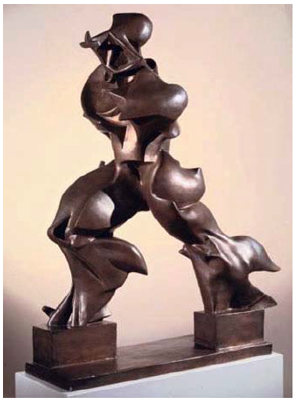
Fig. 1 Umberto Boccioni 1913, Unique Forms of Continuity in Space, Bronze Sculpture, (Tate Museum)
Digging further into the past unveils Leonardo da Vinci’s Mechanical Knight or Leonardo’s Robot (Fig. 2) which he designed and built around 1495, although an actual working piece has never been found and even his drawings seem to be somewhat elusive. Leonardo da Vinci is famous for his many inventions. With his innovative, engineering mind, Leonardo da Vinci had many ideas that employed the use of pulleys, weights, and gears. Certainly, these three components were crucial to many of his automated inventions – including his versions of the clock, air conditioner and hydraulic power saw. (Leonardo Da Vinci Inventions, 2022)

Fig.2 Photo by Erik Möller. Leonardo da Vinci. Mensch - Erfinder - Genie exhibit, Berlin 2005
In the last few decades, artists such as ORLAN (Orlan, 2022) and Sterlac have been considered as pioneers of both posthuman and transhuman embodiment, whose works bring to focus the facilitation of modifying the body and how they can maximise the capabilities of the human body. In this relatively new exploration of the juxtaposition of technology, humans and art, this essay will lean away from the potential origins of artists using extensions for art and focus on the Cyborg Art of more present-day and current Cyborg Artists such as those already mentioned (Harbisson, Ribas and Munoz) and Harshit Agrawal and Joe Dekni.
Harshit Agrawal likes to investigate what he calls the ‘human-machine creativity continuum’- the melding of human and machine creative agency. As well as embracing technology, he uses machines and algorithms and often presents them as an essential part of his art process. Agrawal wants to fully embrace and welcome the becoming of a cyborg artist. He often juxtaposes traditional art media and tools along with machines and computation, creating a space to both direct, and be guided by the machine. (Superare, 2022)
Agrawal produces cyborg art that seeks to define a unity between artificial intelligence, computational art, generative art, traditional art and transcendence. He is a new media artist and particularly uses artificial intelligence (A.I.) symbiotically to produce his work. In his project: Tandem: Imagining Art in Collaboration with an intelligent Machine (Agrawal, 2022) Agrawal creates software that allows the user to input artwork and be guided by A.I. to assist or complete the artwork. Agrawal states that, “Expression through art is core to our very beginning. From cave paintings to digital media, we’ve explored various ways of expressing through art”, and he goes on to ask, “Can something as fundamentally human, be carried out along with an intelligent machine?” Exploring these and other sensitive questions about the relationship between human and machine, Agrawal describes his vision as an attempt to make creative expression a collaboration between humans and machine, that “aims to provide a means of exploring the realms of machine intelligence and imagination in a way very natural to us, that of drawing” (Agrawal, 2022).
A reflection on the relationship that people have with technology is exactly what he wants his work to encourage. Through his work, he invites people to re-evaluate their ever-evolving connection with modern day science. As well as new technologies he uses A.I., drones, sensors, and augmented reality technologies creating both extreme and alternate story boards that technology companies and creators can bring forth, and also providing a platform for the audience to explicitly engage and converse with these, but ultimately, he is being implicitly steered by them. This amplifies the thoughts of Papagiannis and her beliefs that the inclusion of artists within the role of new technology research is imperative (Papagiannis, 2017).
“The reason I’m painting this way,” Andy Warhol explained to an interviewer in 1963, “is that I want to be a machine” (Kamholz, 2013). Though the Pop Artist’s remark may have surprised those who believe that the making of art is antithetical to the soullessness of automated production, his confession in fact merely made explicit an attitude that artists have held for centuries. (Grovier, 2016)
Cyborg artist Joe Dekni, in 2018 got a piece of machinery implanted into his cheekbones that allows him to visualise the space around him in a similar way that a bat or dolphin use echolocation sonar (Fig.3). The artificial organ allows Dekni to feel his surroundings through vibration. The operation took place at the Transpecies Society space in Barcelona and was part of a performance piece that also included an audiovisual installation. (Zas, 2018)

Fig.3 Joe Dekni, 2018, this artist got a piece of machinery implanted in his cheekbones: ID online
In an interview with Raquel Zas, Dekni exclaims that "The first thing I felt upon receiving the vibrations was a burning sensation followed by a feeling of satisfaction. It was similar to what you might feel when getting a tattooing but more intense. Then I felt happiness and pain at the same time," he added. "Cyborg technology is offering us a look into the unknown. My purpose with this project is to perceive the nonphysical or paranormal so I can find further avenues of self-development." (Zas, 2018)
Hopefully, in the future, cyborg technology will help more people improve their lives, those with disabilities and those that just want to enhance themselves. And that is ultimately the goal of Harbisson's Cyborg Foundation: "to be part of the progress." (Zas, 2018)
According to Camilla Jaller, “The picture that cyborg artists paint of the future is highly optimistic, as they believe, that new sensory experiences will push the evolution of cyborgism,” which seems somewhat obvious but nevertheless Jaller adds “that technologically-expanded senses have the potential to positively change the way we experience the world by way of artistic practice and perceptual explorations.”
As well as the new concepts and ideologies within Cyborgism which result in a new type of cyborg artwork, there is the conclusive new way of re-perceiving existing artworks and the world in general. Jaller concludes that, “This new field of cyborg perceptions within the production and experience of art poses a new perspective and new questions regarding the intersection of technology and human perception.” This will inevitably have to be addressed by the artworld as a whole, as Jaller reiterates, “It does so as both concepts change their fixed meanings by ways of the artistic hybridizations of human perception within cyborgism as an artistic movement” (Jaller, 2018).
It is my opinion that ‘Cyborgism’, the art movement, the cyborg artists (and indeed artworks that point discussion towards being cyborg) and their beliefs in transhumanism should be considered of great value to the task of bringing awareness to humans’ relationship with technology and the process of marriage between body and machine. I have no hesitation to suggest that Cyborgism is complementary to theoretical discussion focusing on what it means to become cyborg and the future of humans’ evolutionary adaptions and identity.
I would also echo the conclusive research that Borst achieved through her studies and her conclusion that, “ultimately, cyborg art visually represents the altering human body and the scope of developed and discovered corporeal technologies, which impact on all of us - and future generations. This is the function, value and potency of cyborg art” (Borst, 2009).
REFERENCES:
Borst, E., 2009. Cyborg Art: An Explorative and Critical Inquiry into Corporeal Human-Technology Convergence. [online] Researchcommons.waikato.ac.nz. Available at: <https://researchcommons.waikato.ac.nz/handle/10289/3976?show=full> [Accessed 8 January 2022].
Bostrom, N., 2014. Introduction—The Transhumanist FAQ: A General Introduction. Transhumanism and the Body, [online] pp.1-17. Available at: https://link.springer.com/chapter/10.1057/9781137342768_1, [Accessed 7 January 2022].
Choi, C., 2009. 10 Animals That Use Tools. [online] livescience.com. Available at: <https://www.livescience.com/9761-10-animals-tools.html#:~:text=%2010%20Animals%20That%20Use%20Tools%20%201,larger%20than%20those%20of%20any%20other...%20More%20> [Accessed 14 January 2022].
Cyborg Foundation 2022. [online] Available at: <https://www.cyborgfoundation.com/> [Accessed 14 January 2022].
DeepDove, Style Network., 2022a. ‘Cyborg Anthroopology’, Cyborg Art | Cyborgism. [online] Cyborg Art. Available at: https://www.cyborgart.org/cyborg_anthropology.html, [Accessed 7 January 2022].
DeepDove, Style Network., 2022b. ‘Index’, Cyborg Art | Cyborgism. [online] Cyborg Art. Available at: https://www.cyborgart.org/index.html, [Accessed 7 January 2022].
Ferrando, F., 2014. POSTHUMANISM. [online] Academia.edu. Available at: <https://www.academia.edu/8041656/POSTHUMANISM> [Accessed 8 January 2022].
Grovier, K., 2016. The art of man and machine. [online] Bbc.com. Available at: https://www.bbc.com/culture/article/20161014-the-worlds-first-cybathlon [Accessed 10 January 2022].
Gregory, R. and Zangwill, O. (1987). The Oxford companion to the mind. Oxford: Oxford University Press.
Agrawal, H., 2022. Tandem- Art with an AI | harshit. [online] Harshitagrawal.com. Available at: <http://harshitagrawal.com/works/tandem> [Accessed 14 January 2022].
Huberman, J., 2021. Transhumanism: From Ancestors to Avatars. 1st ed. Cambridge: Cambridge University Press
Hyphenhub 2022. [online] Available at: <https://www.hyphenhub.com/about> [Accessed 10 January 2022].
Jaller, C., 2018. Cyborgism: Artistic Hybridizations of Human Perception. Electronic Workshops in Computing, [online] Available at: <https://www.scienceopen.com/hosted-document?doi=10.14236/ewic/EVAC18.20> [Accessed 10 January 2022].
Kamholz, R., 2013. Andy Warhol and His Process. Contemporary Art. Southerbys. Available at: https://www.sothebys.com/en/articles/andy-warhol-and-his-process [Accessed 10 January 2022]
Keeling, D. and Lehman, M., 2018. Posthumanism. Oxford Research Encyclopedia of Communication, [online] Available at: https://oxfordre.com/communication/view/10.1093/acrefore/9780190228613.001.0001/acrefore-9780190228613-e-627, [Accessed 7 January 2022].
Kreps, D., 2007. Cyborgism: Cyborgs, Performance and Society – David Kreps. [online] Kreps.org. Available at: <https://kreps.org/academic/cyborgism-cyborgs-performance-and-society/> [Accessed 8 January 2022].
Leonardo Da Vinci Inventions. 2022. The Inventions of Leonardo Da Vinci. [online] Available at: <https://www.da-vinci-inventions.com/> [Accessed 8 January 2022].
Levin, G., 2009. Flong Blog + News » New Media Artworks: Prequels to Everyday Life. [online] Flong.com. Available at: <http://www.flong.com/blog/2009/new-media-artworks-prequels-to-everyday-life/> [Accessed 10 January 2022].
Orlan. 2022. Orlan: Body Modification as a Way to Create an Art - Orlan. [online] Available at: <https://www.orlan.net/orlans-body-modifications/> [Accessed 10 January 2022].
Papagiannis, H., 2017. Augmented human. Sebastopol, CA: O'Reilly Media.
Pearlman, E., 2015. I, Cyborg. PAJ: A Journal of Performance and Art, 37(2), pp.84-90. Available at: <https:// https://www.academia.edu/12592330/I_Cyborg, [Accessed: 6th January 2022].
Shambare, R., Rujimbana, R. and Zhowa, T., 2012. Are mobile phones the 21st century addiction?. AFRICAN JOURNAL OF BUSINESS MANAGEMENT, [online] 6(2). Available at: <https://academicjournals.org/journal/AJBM/article-abstract/F86F13618106> [Accessed 14 January 2022].
Tate. 2022. ‘Unique Forms of Continuity in Space’, Umberto Boccioni, 1913, cast 1972 | Tate. [online] Available at: <https://www.tate.org.uk/art/artworks/boccioni-unique-forms-of-continuity-in-space-t01589> [Accessed 8 January 2022].
WikiDiff. 2022. Posthuman vs Transhuman - What's the difference?. [online] Available at: <https://wikidiff.com/posthuman/transhuman> [Accessed 14 January 2022].
Zas, R., 2018. this artist got a piece of machinery implanted in his cheekbones. [online] I-d. Available at: <https://i-d.vice.com/en_uk/article/gye7kw/artist-joe-dekni-cyborg-cheekbone-implant> [Accessed 10 January 2022].
Bibliography (other than references):
BBC. 2022. BBC Radio 4 – Living with Artificial Intelligence: The Reith Lectures. [online] Available at: <https://www.bbc.co.uk/programmes/b00729d9> [Accessed 14 January 2022].
Bradley, Katherine, 2015: Envisioning our posthuman future: Art, Technology and Cyborgs. Available at: https://www.academia.edu/16783622/Envisioning_Our_Posthuman_Future_Art_Technology_and_Cyborgs [Accessed 10 January 2022].
Herr, H., 2022. How we'll become cyborgs and extend human potential. [online] Ted.com. Available at: <https://www.ted.com/talks/hugh_herr_how_we_ll_become_cyborgs_and_extend_human_potential> [Accessed 14 January 2022].
Illustration List:
Page 6: Fig. 1 Umberto Boccioni 1913, Unique Forms of Continuity in Space, Bronze Sculpture, (Tate Museum)
Page 7: Fig.2 Photo by Erik Möller. Leonardo da Vinci. Mensch - Erfinder - Genie exhibit, Berlin 2005
Page 8: Fig.3 Joe Dekni, 2018, this artist got a piece of machinery implanted in his cheekbones: ID online
Comments