Sculpture Progress & Contextual Studies 07.01.23
- Aldous George

- Jan 7, 2023
- 4 min read
A couple of extracts from my essay in progress that I feel help understand where my work is coming from: Art: The Reality Machine
(From the Intro) I would like to put forward my concerns that the Anthropocene along with a transhumanistic outlook could be the downfall of humanity or at least strip us of our ‘being human’ as we know it at present. I feel that humanity has embarked on a transitionary period of allowing transhumanistic goals of becoming an advanced superhuman to potentially damage our ecological existence with nature and the planet. Before the irreversible emergence of a transhumanistic posthuman evolves or before humanity self-destructs, I would like to use this essay to encourage what I feel as an inevitable fall back to old ways, our connection to nature and a rekindling of passing on fundamental life skills and knowledge. In short, I have concerns about the possible Icarus effect of pursuing transhumanism, where failure is possibly brought about by the very elements that will lead to an initial success. Both art and nature will be ever more important and artists and contemporary philosophers such as Timothy Morton are playing a major role in helping the world acknowledge and bring about change.
From the conclusion) Along with all the artists, writers and thinkers mentioned in this essay and many more, my work aims to be an awareness machine and reality checker for issues for humanity to consider, ponder and act for change, and in a maybe not so abstract way. I create debate for technological ontology to be questioned and a reconnection with nature to be considered and shared as well as giving my opinion which may come across as slightly incendiary, which I feel is a basis to instigate questionable thought into my reader and do not want to come across as having a neutral stance. My work explores the boundaries of what it is to be mentally and physically 'human' alongside humanity's obsession with evolving beyond its current limitations, especially by means of science and technology. Working within the conceptual terrain of transhumanism and cyborgism, I employ physical structures and prostheses, processual audio and visual material to immerse an audience within the blurry area between human and machine and our inevitable transcendence and connection with technology and what this means for our relationship with nature. My work is exploratory, embodied and powerfully performative, using my sculpture as subject and sounds from my materials and tools as well as from nature, augmented by manufacturing techniques to stretch the limits and senses of the human to create an audio joyride of visual imagery. My culminating work for my MA will consist of sculpture and moving image that has evolved to represent transhumanism, and now embraces my message to reconnect with nature, or is it nature rewilding humanity?
Once upon a time in Finland, there were little forest spirits who could put spells on people who were too noisy or treated the forest with disrespect. The victims would experience a condition called metsanpietto, which translates as being “covered by the forest.” - Florence Williams (Williams, F. 2018)
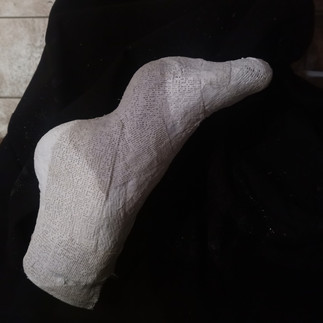
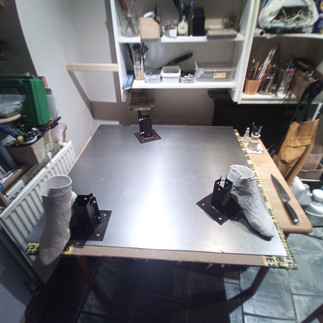
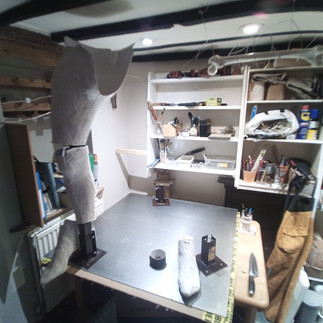
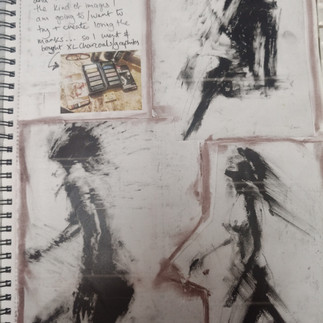
Images of sculpture work so far, A metre square steel base and deciding where to position the anchor points and some old and new sketch book material/research. Beyond the images, some artists that I am looking at with regards to figurative sculpture.













Thomas Houseago brings a vanguard approach to sculpture’s original subject, the human body. Utilizing mediums associated with classical and modernist sculpture—such as carved wood, clay, plaster, and bronze—as well as less traditional materials like rebar and hemp, Houseago builds monumental figures rife with the traces of their making. Body parts rendered from flat portions of wood adjoin others sculpted in the round to create an interplay between two- and three-dimensional elements. His bulky-shouldered figures replace the grace of their serpentine contrapposto stance with awkward contortions of piecemeal appendages. Crouched and stilted on thick limbs, these reductive interpretations convey a striking sense of weight and anatomical structure. By tapping into the nuanced legibility of the human form, Houseago’s figures oscillate between states of power and of vulnerability.

Although Segal started his art career as a painter, his best known works are cast life-size figures and the tableaux the figures inhabited. In place of traditional casting techniques, Segal pioneered the use of plaster bandages (plaster-impregnated gauze strips designed for making orthopedic casts) as a sculptural medium. In this process, he first wrapped a model with bandages in sections, then removed the hardened forms and put them back together with more plaster to form a hollow shell. These forms were not used as molds; the shell itself became the final sculpture, including the rough texture of the bandages. Initially, Segal kept the sculptures stark white, but a few years later he began painting

With an incredibly visual, active mind, British contemporary artist Rachel Ducker has an insatiable desire to create and make. Well practiced in life drawing and with an appreciation of the human form and the emotional dynamics of human nature, combined with being originally trained as a jeweller, lead her to experiment with wire as a medium for sculpting the human form, capturing something ephemeral, either emotive or active.
Her pieces are untitled due to her belief that everyone sees something different in the sculptures and her lack of suggestion leads them to live that moment she portrays in their own particular way, therefore expanding the piece of work further with every viewer.
The translucency and form of her work allows rather dramatic shadows to be cast and with the right lighting, can show the three dimensional form on a two dimensional level creating an effect resembling a pencil sketch on the wall.
Comments